



Elucidation of the Physicochemical Properties and Transformation Processes of Atmospheric Aerosols and Evaluation of Their Biological Effects
In Asia, in addition to anthropogenic particles derived from fossil fuel combustion—which are increasing due to rapid economic development—organic carbon particles from biomass burning and natural particles such as Asian dust (mineral dust) and pollen are emitted. These particles undergo transformation as they disperse and are transported. Given their impact on both climate change and human health, we have conducted observations and laboratory experiments to understand their properties (composition, optical characteristics, etc.) and transformation processes, as well as source estimation using statistical models.
For instance, we have found that polycyclic aromatic hydrocarbons (PAHs), which are generated by the combustion of fossil fuels, undergo chemical changes into more harmful compounds (PAH derivatives) when they bind to Asian dust particles. In addition to measuring the concentrations of PAHs and PAH derivatives in the ambient atmosphere, laboratory reaction experiments using a smog chamber are being performed to study the formation mechanisms of PAH derivatives through atmospheric reactions. In addition, research is underway to assess their biological effects.
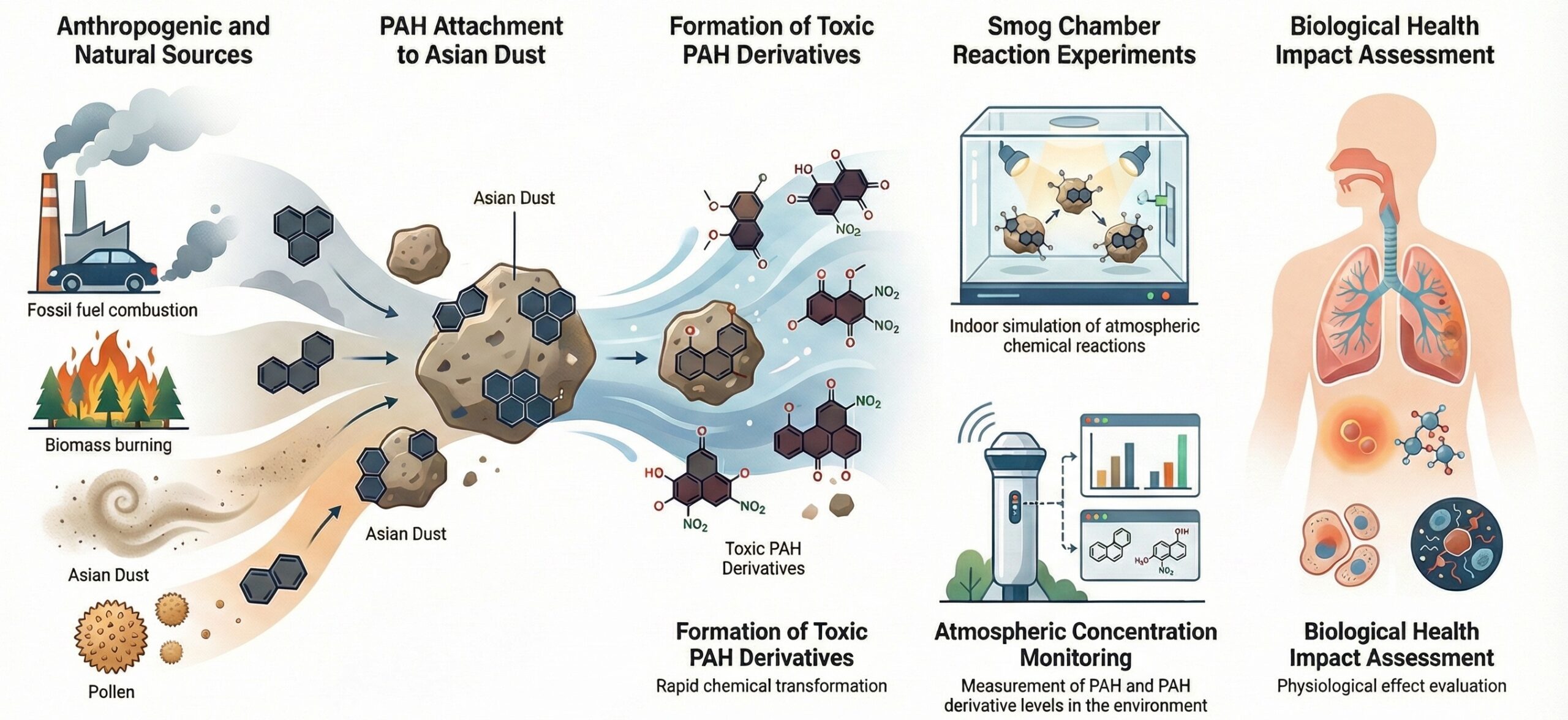
Development of New Measurement Methods for Atmospheric Aerosol Components and Their Application to Observations
Many of the harmful chemicals contained in atmospheric particles exist at extremely low concentrations. To clarify their concentrations and behavior in the environment, highly sensitive and accurate analytical methods are required. Therefore, we are developing novel analytical methods using High-Performance Liquid Chromatography (HPLC) and Gas Chromatography–Mass Spectrometry (GC-MS), and conducting observations that combine these with continuous measurements—such as black carbon (BC; an indicator of fuel combustion)—using automated instruments. We are also focusing on the magnetic properties of atmospheric particles as an indicator of harmful metallic components. The application of these methods to real-world atmospheric observations is expected to enable more detailed monitoring of the atmospheric environment and to elucidate previously overlooked health risks.
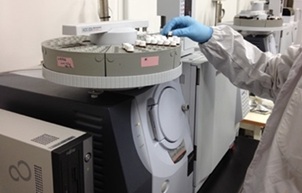
Analysis of hazardous chemicals by GC-MS
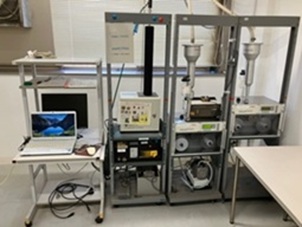
Observation of BC in the atmosphere
Development of Novel Nanomaterials for Environmental Applications
With increasing human population and activities, new classes of organic chemicals are being released into the environment. These contaminants may persist in atmospheric aerosols, surface waters or oceans, soils, as well as other parts of the environment. However, the risks and hazards of most of these chemicals remain unknown. To cope with increasing concerns toward these emerging contaminants, it is important to develop low-energy and effective methods for their treatment and removal. Nanomaterials such as metal–organic frameworks (MOFs) and porous molecular crystals, represent a class of materials that are potentially useful for such applications. Our research involves the synthesis of these nanomaterials, as well as the development of new methods for the removal of various environmental pollutants. In addition, we are also interested in the design and synthesis of luminescent materials for the preparation of sensors, photoswitches and other organic devices.
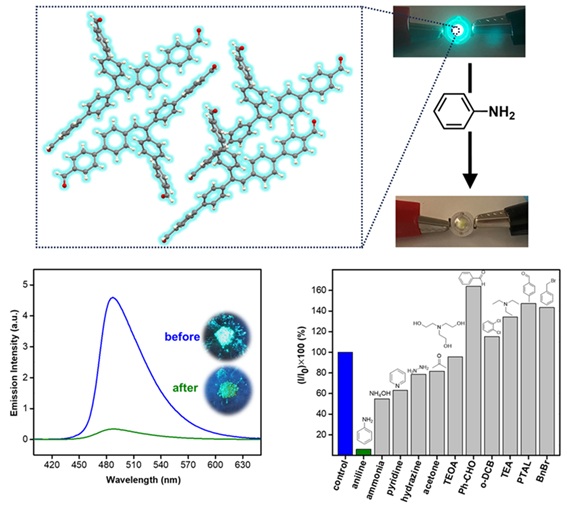
Sensing volatile organic compounds (VOCs) by using a newly-synthesized organic crystal
